 University of North Texas


Chamari Viyanga Kusalani Ileperuma is a Ph.D. student at UNT conducting her doctoral research in analytical chemistry under the mentorship of Dr. Francis D’Souza.
Chamari Viyanga Kusalani Ileperuma is a Ph.D. student at UNT conducting her doctoral research in analytical chemistry under the mentorship of Dr. Francis D’Souza. She recently began her fifth and final year of Ph.D. work, which involves the study of intricate, multi-modular, donor-acceptor molecular systems. Viyanga said she is passionate about using science to address real-world challenges, finding it especially fascinating that molecular-level interactions can be designed and controlled to create functional materials.
 “My interest in this research grew from a long-standing curiosity about how nature
captures and uses energy so efficiently,” said Viyanga, who began her academic journey
at the University of Peradeniya, one of Sri Lanka’s most prestigious universities.
“During my undergraduate studies, natural processes such as photosynthesis and solar-energy
conversion particularly fascinated me. I wanted to better understand the molecular
principles behind how nature captures, transfers, and utilizes energy.”
The molecular events Viyanga investigates in the lab resemble some of the fundamental steps involved in natural photosynthesis. To study these extremely fast processes, she uses advanced analytical techniques such as ultrafast transient absorption spectroscopy to track molecular events occurring within extraordinarily short timescales. Combined with electrochemical and computational methods, this process helps her understand how molecules can be designed to capture and manage light energy more effectively.
“I study how molecular architectures can be designed to capture light and control energy and electron transfer,” she said. “Learning from nature and using chemistry to develop systems that could contribute to practical technologies gave this research a deep purpose for me; as I became involved in ultrafast spectroscopy and observed these light-driven molecular events experimentally, that initial curiosity developed into a genuine passion for this field.”
 Viyanga holds a diploma in computer science, with a background in programming and web development,
and has independently developed graphic design and video editing skills. While at UNT, she began combining her chemistry research background with scientific
graphic design, creating captivating art inspired by analytical chemistry projects.
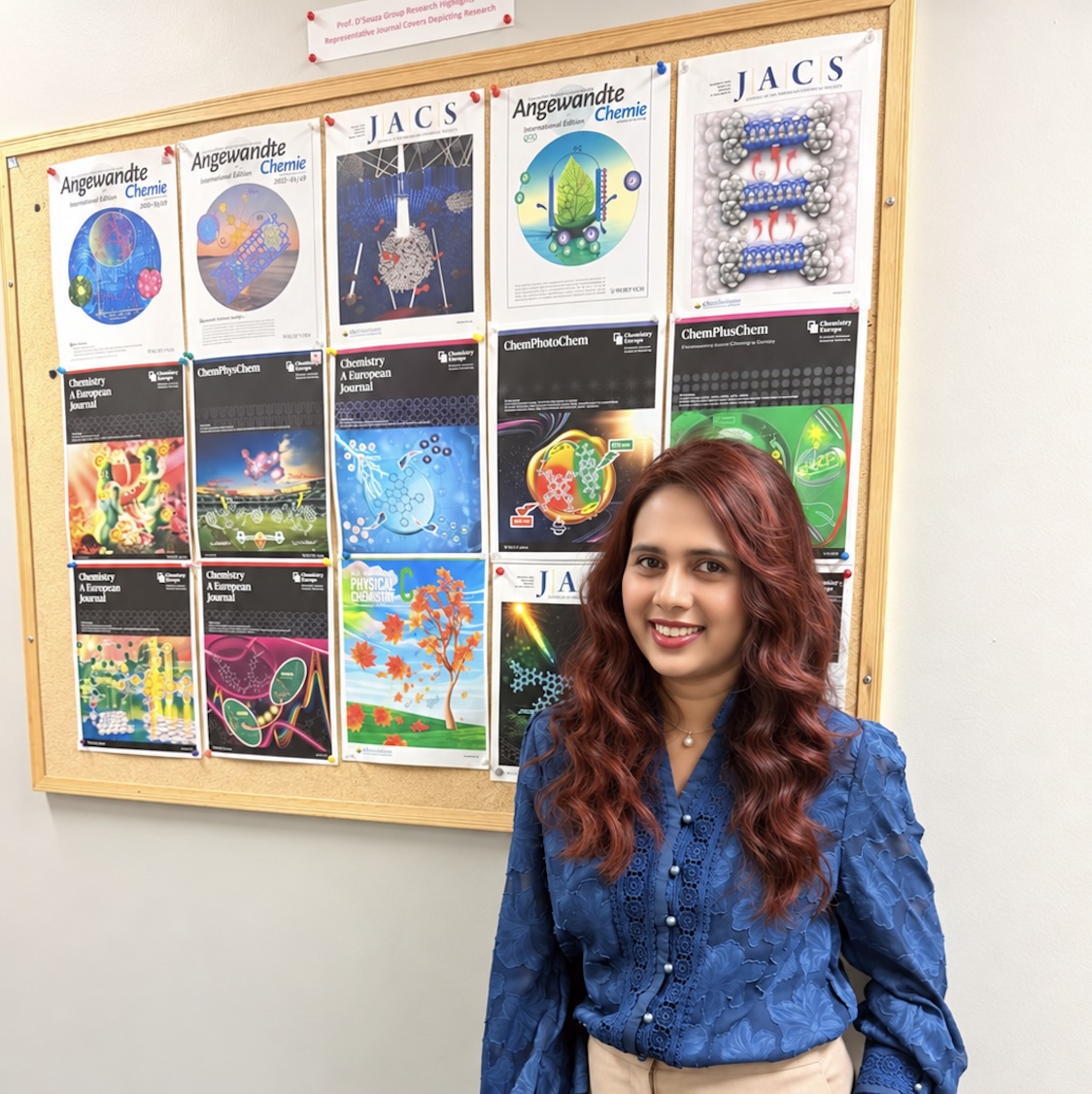
To date, she has designed nine journal cover artworks representing research from Dr.
D'Souza's group, all of which were selected and published by the respective journals.
“Designing those covers required me to understand research beyond my own work and translate complex molecular and photophysical concepts into visual scientific narratives,” she said. “Having my most recent artwork selected as a Journal of the American Chemical Society (JACS) supplementary cover has been the most significant milestone in this creative aspect so far!”
Besides her designs appearing on the covers of numerous additional journals including Chemistry - A European Journal, ChemPlusChem, ChemPhotoChem, Chemical Science, and EES Solar, Viyanga has also published multiple peer-reviewed research articles, won several scholarships and travel awards, and presented her research at national and international conferences.
Viyanga originally chose UNT because of its strong graduate program in chemistry. Her primary mentor, Dr. Francis D’Souza, is a world-renowned researcher, recently honored with the 2024-2025 UNT Foundation Eminent Faculty Award and the 2026 Hans Fischer Career Award for Lifetime Achievement from the Society of Porphyrins & Phthalocyanines (SPP). She said his mentorship, reliability, and encouragement have been instrumental in shaping her growth as an independent researcher.
“Joining Dr. D’Souza’s research group introduced me to new areas of chemistry, challenged me to grow as an independent researcher, and opened opportunities for publications, international collaborations, conference presentations, teaching, and combining my passion for graphic design with science,” she said. “Looking back, I can see how the support I received at the beginning of my journey and the opportunities I have found along the way played such an important role in shaping the scientist and person I am today.”
As her doctoral work nears completion, Viyanga said she is looking forward to wrapping up her remaining research projects, publishing the work, and successfully defending her dissertation. She plans to earn her Ph.D. in 2027.
“Reaching this milestone will represent not only the completion of my doctoral degree, but also years of learning, perseverance, and growth as a scientist,” she said. “Beyond graduation, I hope to pursue a career as a research scientist, where I can continue exploring fundamental molecular processes and developing advanced functional materials. My ultimate goal is to contribute to something larger than myself; using science to serve society by advancing green, sustainable, and environmentally friendly energy solutions."