 University of North Texas

Bibek Sapkota is a UNT chemistry graduate student whose doctoral research focuses on Raman spectroscopy, materials characterization, PFAS detection, and applications related to semiconductor manufacturing and environmental monitoring.
Bibek Sapkota is a UNT chemistry graduate student whose doctoral research focuses
on Raman spectroscopy, materials characterization, PFAS detection, and applications
related to semiconductor manufacturing and environmental monitoring. His research,
which is supported by the Semiconductor Research Corporation (SRC) and the Welch Foundation, led him to participate in the recent UltraFacility conference,
a gathering of semiconductor industry professionals and leaders.
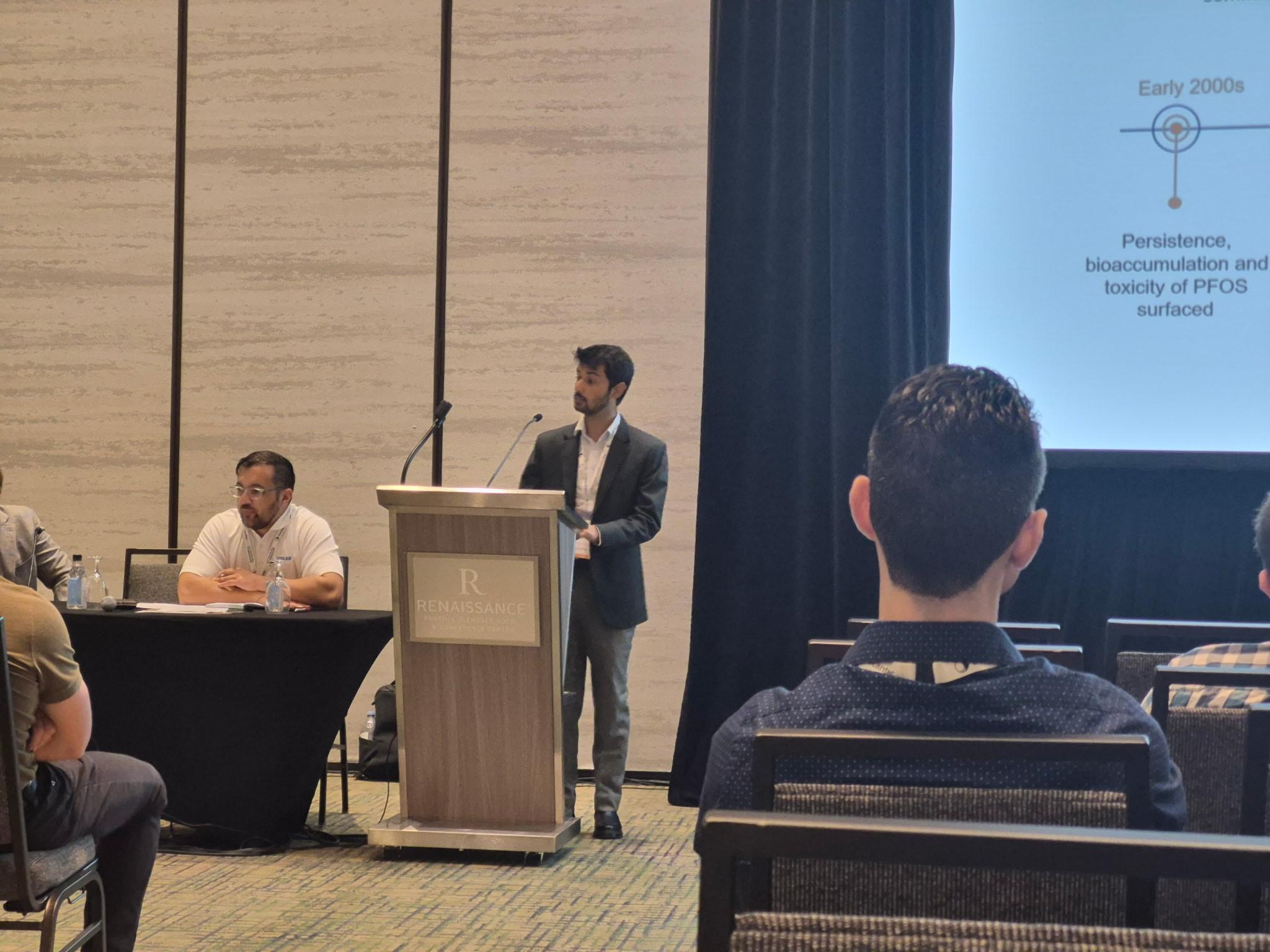
“The conference provided an opportunity to connect my academic work with current challenges in semiconductor manufacturing and advanced facility operations,” said Bibek, who is conducting his research work in the lab of Dr. Hao Yan. “One of the most valuable aspects of the conference was learning about current issues in semiconductor fabrication, materials, contamination control, and environmental sustainability.”
“The conference provided an opportunity to connect my academic work with current challenges in semiconductor manufacturing and advanced facility operations,” said Bibek, who is conducting his research work in the lab of Dr. Hao Yan. “One of the most valuable aspects of the conference was learning about current issues in semiconductor fabrication, materials, contamination control, and environmental sustainability.”
At the conference, Bibek presented his research on developing a high-resolution Raman
spectral library for PFAS and its detection in wastewater using nanostructure-augmented
substrates.
“This work uses Raman spectroscopy to characterize PFAS compounds and develop sensitive detection approaches for low-concentration measurements,” he said. “This research is relevant to semiconductor manufacturing because PFAS-containing materials and processes can create environmental and water-treatment challenges.”
“This work uses Raman spectroscopy to characterize PFAS compounds and develop sensitive detection approaches for low-concentration measurements,” he said. “This research is relevant to semiconductor manufacturing because PFAS-containing materials and processes can create environmental and water-treatment challenges.”
The conference gave Bibek the opportunity to interact with researchers and professionals
from the semiconductor and advanced manufacturing communities. He said the discussions
he had at the event helped him better understand how academic research can be translated
into industrial applications and allowed him to think more broadly about the potential
impact of his dissertation research.
“With my background in chemistry and spectroscopy, I found it especially useful to
see how analytical chemistry, surface characterization, and materials science can
be applied to practical problems in semiconductor manufacturing,” he explained. “Overall,
attending UltraFacility was valuable for both my academic and professional development.
It allowed me to present my research to an audience outside my immediate research
group, receive feedback from experts, learn about emerging challenges in the semiconductor
industry, and develop professional connections.”