 University of North Texas

Abdullah Ali Maruf is a UNT graduate student working in the surface chemistry lab of Dr. Jeffry Kelber on two separate but related projects in transition metal carbide catalysts and diamond surface properties.
Abdullah Ali Maruf is a UNT graduate student working in the surface chemistry lab
of Dr. Jeffry Kelber on two separate but related projects in transition metal carbide catalysts and diamond
surface properties. Abdullah recently earned an award for his research from the American
Chemical Society’s Division of Catalysis Science and Technology (CATL) at the 2026
ACS conference in Chicago.
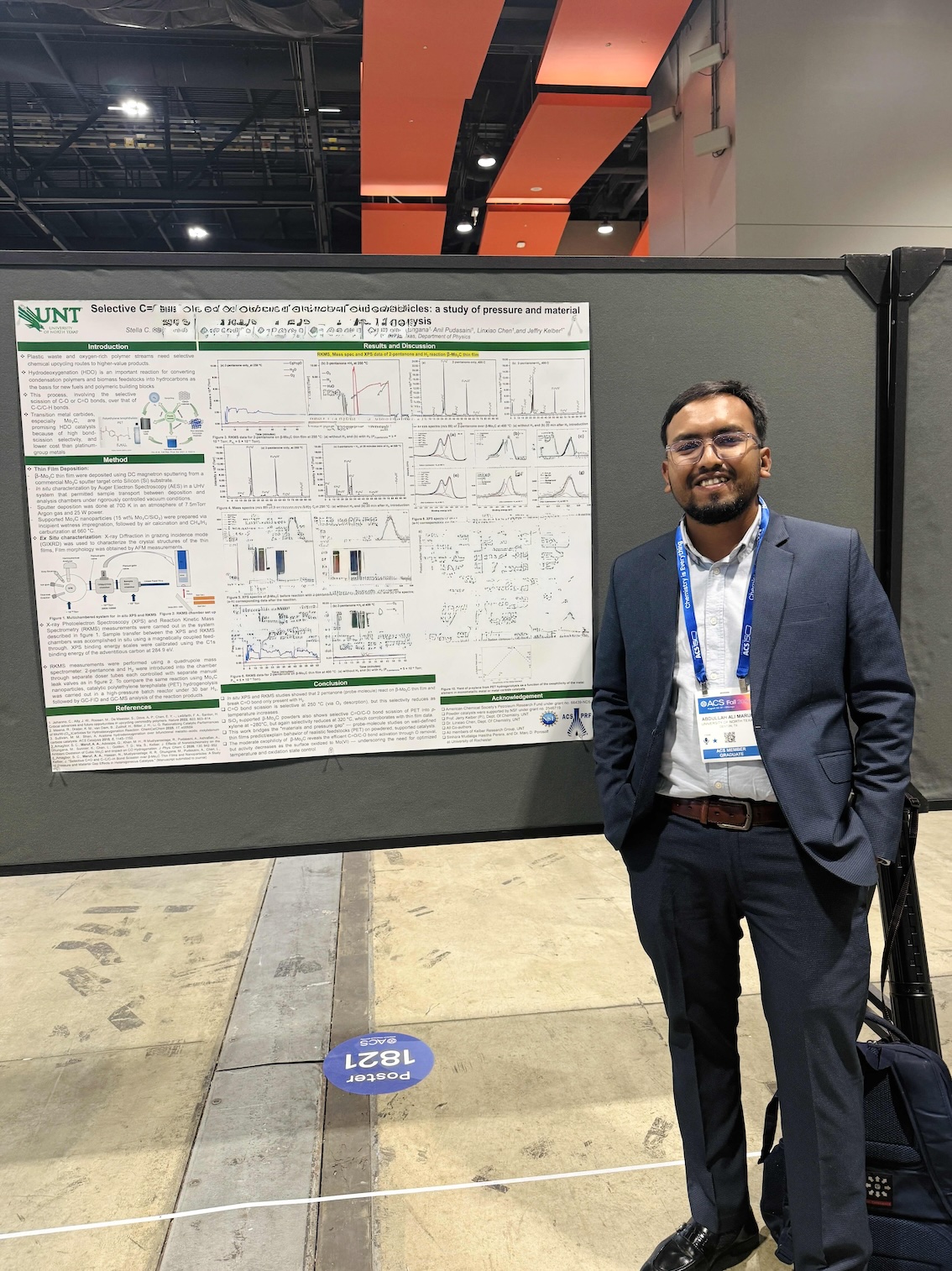 “I presented my work on transition metal carbide catalysts, specifically how their
surface chemistry influences catalytic reactions and what that could mean for many
important applications like plastic upcycling,” said Abdullah, who completed his undergrad
and master’s degrees at the University of Chittagong in Bangladesh before coming to
UNT three years ago. “This award reminded me that persistence in research really matters;
it encouraged me to keep asking important questions, improving my work, and sharing
it with the broader scientific community.”
“I presented my work on transition metal carbide catalysts, specifically how their
surface chemistry influences catalytic reactions and what that could mean for many
important applications like plastic upcycling,” said Abdullah, who completed his undergrad
and master’s degrees at the University of Chittagong in Bangladesh before coming to
UNT three years ago. “This award reminded me that persistence in research really matters;
it encouraged me to keep asking important questions, improving my work, and sharing
it with the broader scientific community.”Abdullah said that he is motivated not just by understanding the fundamental science
of surface chemistry but unlocking the mysteries of how these surfaces work at the
molecular level. He said this knowledge could eventually allow scientists to develop
chemical processes that are cleaner and more energy efficient.
“In practice, our research allows us to build catalysts out of earth-abundant elements
for carbon conversion and plastic upcycling, improving semiconductor thin-film interfaces
at the atomic level,” he said. “This kind of surface science can influence energy,
manufacturing, and technology capabilities, and my hope is that my research can bridge
fundamental science with real applications in clean energy and advanced electronics.”
He credits his advisor, Dr. Jeffry Kelber, for helping him grow as a researcher at
UNT, not just by his experienced leadership in ideas and direction, but by pushing
him to think independently and look at problems from different angles. Abdullah has
also had the opportunity to work closely with Dr. Linxiao Chen, another faculty researcher
in the chemistry department.
“Through our collaboration, Dr. Chen has mentored me in different aspects of catalysis
research and helped me expand my knowledge in this area. Working with his group has
given me the opportunity to learn new techniques and explore research questions from a
different perspective,” said Abdullah. “I am very thankful to all the members of the
Kelber research group as well, especially my lab colleague and mentor, Stella Amagbor,
who has helped me to learn surface science techniques, develop research ideas, and troubleshoot
experimental problems. Research really isn’t about a solo effort, and having people around who support
you makes a real difference, both academically and personally.”
Another part of his research work is with his lab mate, Renuka Nilmini, focusing on
studying diamond surfaces in collaboration with Dr. Nigel D. Shepherd (UNT Material
Science and Engineering).
“Diamond has unusual properties that make it exciting for next-generation electronics
and quantum technology; getting a better handle on those interfaces could improve
how reliable and high-performing future electronic devices are,” said Abdullah. “Though
they sound like two different projects, they’re built on the same question — what’s
happening at a material’s surface, and how do we control it. My hope is that this
work can bridge fundamental surface science with real applications in clean energy,
catalysis, and advanced electronics."
This spring Abdullah received an Outstanding Teaching Assistant Award, as well as
the Dr. Linda Truitt Creagh Travel Award and a UNT College of Science Travel Award,
both of which helped fund his trip to the ACS meeting in August.
“Overall, the conference was not just about receiving an award,” he said. “It was
a great opportunity for me to grow as a researcher, make new connections, and become
even more excited about where my research can take me in the future.”
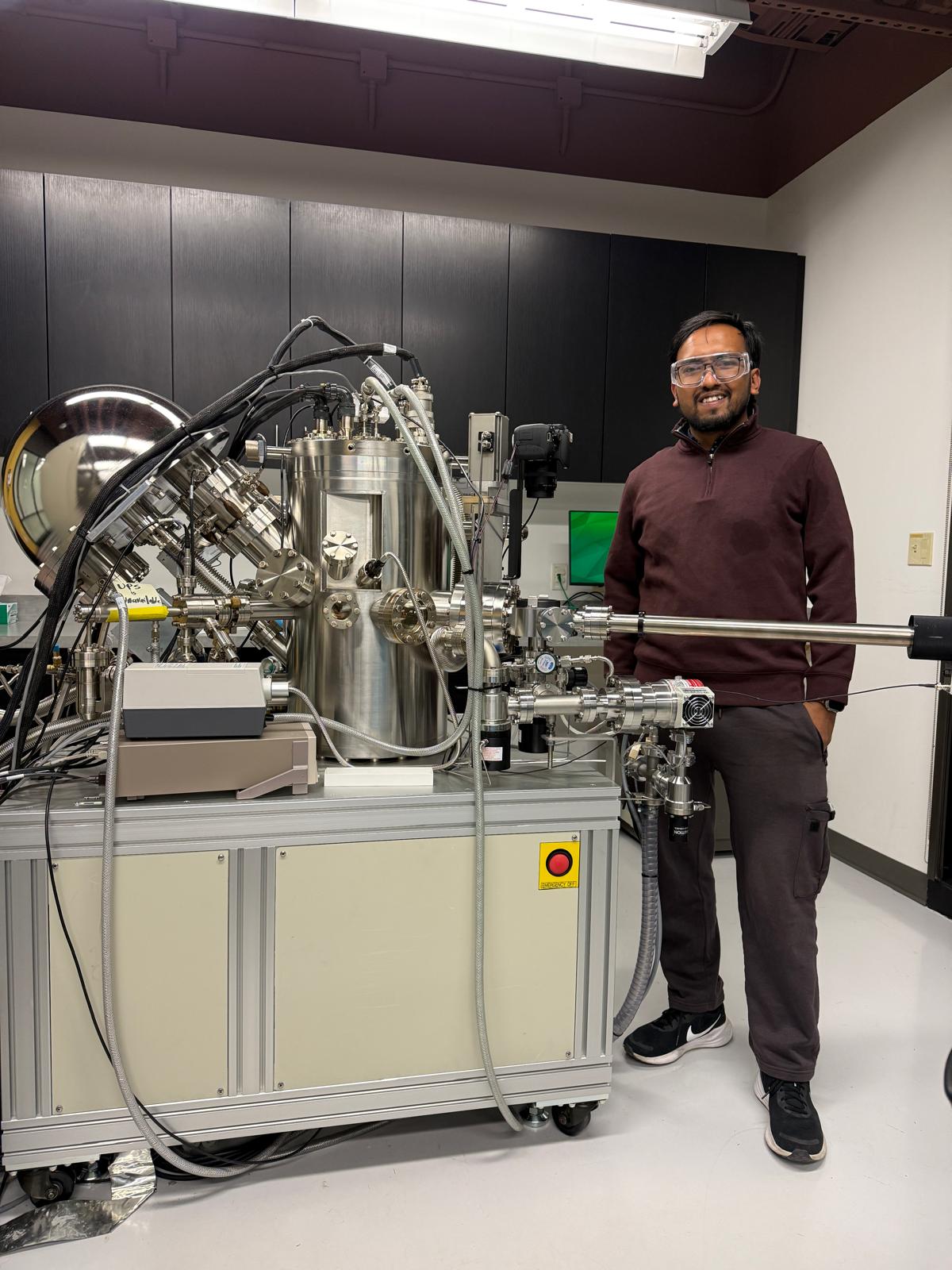 Abdullah was drawn to UNT when he was searching for a strong graduate program where
he could pursue independent research in the field of his choice, with access to state-of-the-art
research facilities and instrumentation.
Abdullah was drawn to UNT when he was searching for a strong graduate program where
he could pursue independent research in the field of his choice, with access to state-of-the-art
research facilities and instrumentation."Graduate research comes with a lot of challenges, and while not every experiment
works the way you expect, each challenge teaches you something new,” he said. “The
opportunities I have had at UNT—to conduct research, collaborate with different groups,
attend conferences, and communicate my work—have helped me grow significantly, not
only as a researcher but also as a person.”
As he moves closer to the final stage of his Ph.D., Abdullah is excited to bring together
the different parts of his research by completing and publishing his findings to share
with the broader scientific community.
“I’m excited to continue collaborating and learning new techniques. One thing I have
really enjoyed during my graduate studies is that there is always something new to
learn, and sometimes an unexpected experimental result can lead you in a completely
new direction,” he said. “I hope the coming year will be a year where I can turn a
lot of the work we have been doing in the lab into meaningful scientific contributions
and continue growing as an independent researcher.”