 University of North Texas

The UNT College of Science is pleased to welcome Dr. Colin Burke to the physics department this semester as Assistant Professor.
The UNT College of Science is pleased to welcome Dr. Colin Burke to the physics department
this semester as Assistant Professor. Dr. Burke researches the optical variability
or “flickering” of accreting black holes and recently finished an NSF Postdoctoral
Fellowship at Yale University before joining the faculty at the University of North
Texas.
 “At UNT, we have access to data from US-funded observatories, such as the Rubin Observatory
in Chile. UNT faculty member Dr. Ohad Shemmer is heavily involved in these projects,
and I am looking forward to many fruitful opportunities for collaboration,” said Dr.
Burke. “I was also very impressed by UNT's curious and motivated students; they have
a lot of grit. I could not turn down the chance to be a part of the UNT community
and contribute to its growing influence on the world stage.”
“At UNT, we have access to data from US-funded observatories, such as the Rubin Observatory
in Chile. UNT faculty member Dr. Ohad Shemmer is heavily involved in these projects,
and I am looking forward to many fruitful opportunities for collaboration,” said Dr.
Burke. “I was also very impressed by UNT's curious and motivated students; they have
a lot of grit. I could not turn down the chance to be a part of the UNT community
and contribute to its growing influence on the world stage.”In his field of study, Dr. Burke is known for the discovery of a relationship between
the characteristic timescale of optical variability and the mass of the black hole,
which can be used as a new way to measure black hole masses.
“This research helps us better understand the Universe we all inhabit,” he said. “In
the long term, we aim to answer questions like: How did supermassive black holes form
in the early Universe? How do they influence the growth and evolution of their host
galaxies? How do black holes grow by accretion and mergers over cosmic time?”
Needless to say, Dr. Burke brings a wealth of experience in state-of-the-art statistical
modeling and inference methods that will prove very valuable in the big data era of
astronomy. His research work has connected him with collaborators from all over the
world, from Canada to Chile and abroad.
“I am currently using data from advanced telescopes such as the Rubin Observatory
in Chile and the Keck Observatory in Hawaii. For the most part, the data is sent remotely
to our computers where we do the science,” he explained. “Getting to visit an observatory
in person is a rare treat these days, but I sometimes make use of high-performance
computing facilities to run big data analyses.”
Dr. Burke will be teaching a class on observational astronomy in the Spring.
“Observational astronomy has changed significant in recent years, with advancements
in data science and AI, new telescopes that monitor the night sky in real-time, and
the detection of gravitational waves from astrophysical sources that is opening a
new window into the Universe,” he said. “I am excited to incorporate these recent
developments into the class and my research.”
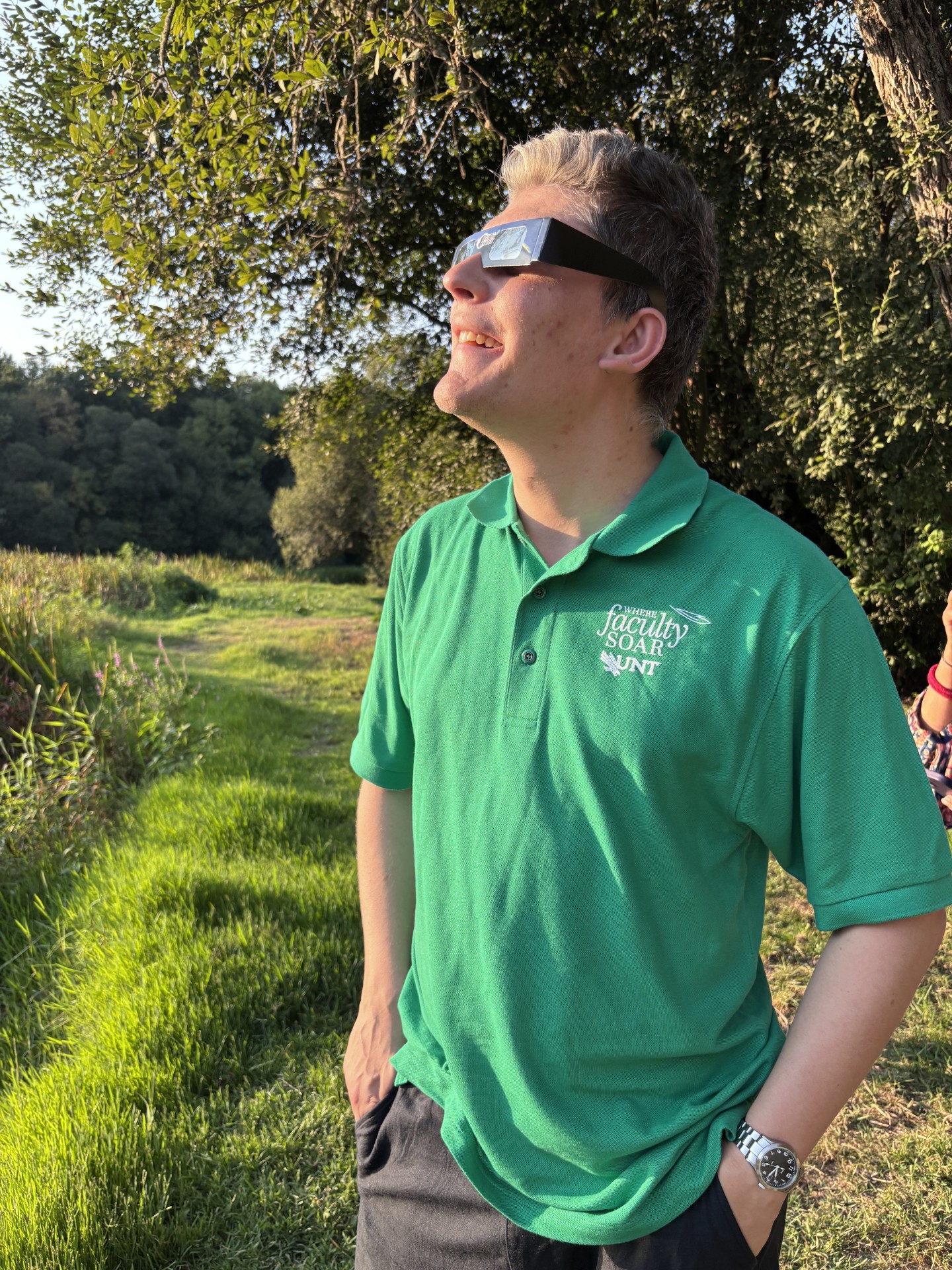
Dr. Burke has seen a total of three total solar eclipses in the past ten years, including
the most recent eclipse in Spain this August (pictured). His advice to students: “Always
work on topics that interest and excite you. That will keep you motivated and enable
you to do your best work.”