 University of North Texas

Researchers at UNT are entering the second phase of a project to develop infrared sensors that go beyond current capabilities for thermal imaging.
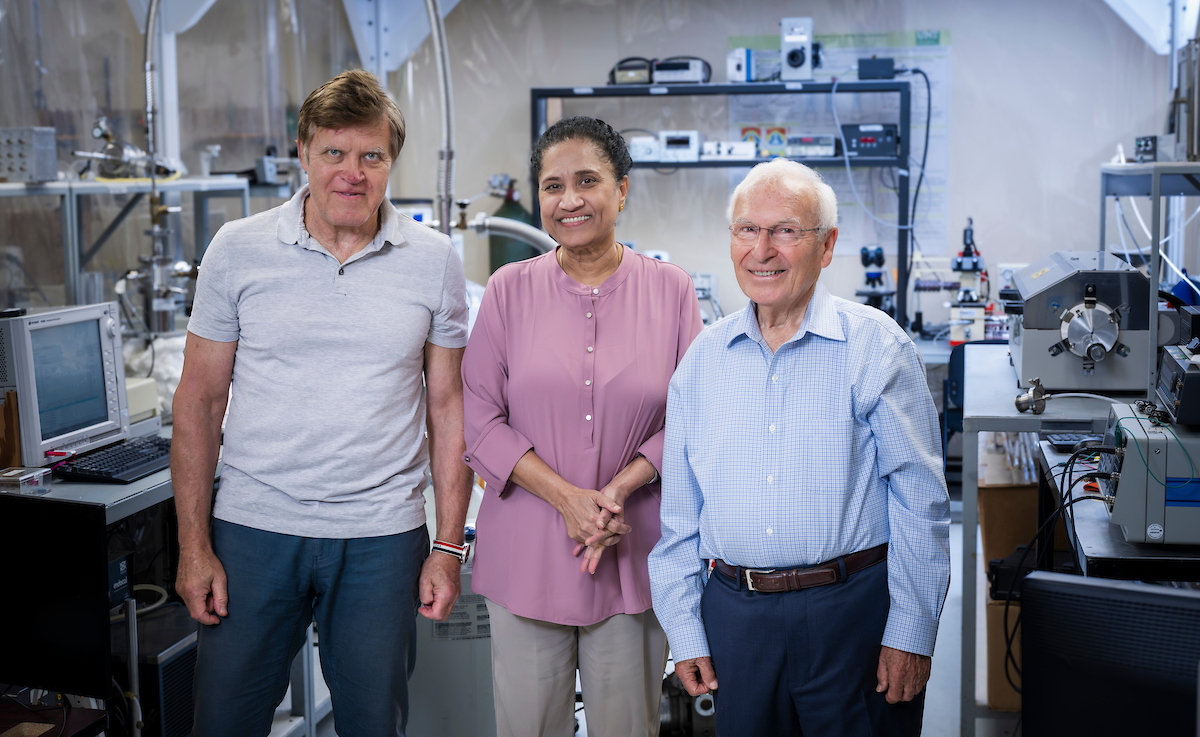
Researchers at UNT are entering the second phase of a project to develop infrared sensors that go beyond current capabilities for thermal imaging. Dr. Usha Philipose, UNT physics professor, is leading the project. She’s joined by Drs. Arkadii Krokhin, Dr. Chris Littler and A. J. Syllaios, all from the physics department.
 “Our goal is to investigate the fundamental properties of materials associated with
thermal sensing and thus contribute to the development of efficient, reliable and
sensitive imaging systems,” Dr. Philipose said.
“Our goal is to investigate the fundamental properties of materials associated with
thermal sensing and thus contribute to the development of efficient, reliable and
sensitive imaging systems,” Dr. Philipose said.
The team is supported by a grant from the U.S Army’s Small Business Innovation Research and Small Business Technology Transfer Program. They’re also working alongside Syllaios’s company, TKSInfrared. The total amount awarded to phase two is $1.38 million over two years.
The goal of the overall project is to improve bolometer-based sensors that detect heat instead of visible light. Thousands of these microscopic sensors work together to create thermal images used in applications from military night vision to supporting firefighting.
“For example, say firefighters need to go into a burning house to rescue people, but they cannot see because of all the smoke. These sensors can pick up the thermal differences between a person and the fire,” Dr. Syllaios said. “What we want to do is make current sensors even more sensitive to temperature differences.”
The team will focus on the leg component of the bolometer which controls its thermal isolation. “There are very specific properties of the leg material that will dictate how efficiently the imaging process will work Improved thermal isolation lets the sensor detect smaller temperature differences," Dr. Philipose said
The team’s new materials aim to achieve that without sacrificing the sensor’s durability.
The first phase was a feasibility study where the team demonstrated that they could engineer materials with appropriate electrical and thermal properties. In phase two, they’ll test different materials to prove their capability while showing they can be manufactured using existing processes in the semiconductor industry.
“The ultimate goal is that the sensor can detect less than a degree change in temperature,” Dr. Philipose said.
To help make that goal a reality, the team will train undergraduate and graduate students, allowing them to get hands-on experience.
“We’ve worked with several students over the years on applied science projects like this who work in industry now,” Dr. Syllaios said. “Many are hired even before they graduate. This is relevant work to what the industry wants.”
There are currently four graduate students and two undergraduate students from the College of Science on the project.
“There is a path forward for these students,” Dr. Philipose said. “They’re not just studying the science. They’re applying it to current state-of-the-art commercial products. We are very happy we were able to get this grant and provide that opportunity for them.”
Via UNT News